
 uncategorized
[Editor’s note: The world has entered into a recession for the first time since the great recession. The causes are very different, but one thing is certain: uncertainty. In this post, Bala GR, Head of Business Intelligence at Radix, evaluates what happened to domains during the last recession and what might happen this time.]
A lot has already been spoken about the strange turn of events that have kept the global economy on the hook this year. Sure, we expected a recession; it was a long time due. What we didn’t expect was a pandemic and a worldwide self-quarantine for months on end. A few years from now, we will be looking back at 2020 with awe and absurdity in equal measure.
Talking of looking back, this year opens up the perfect opportunity to examine the 2008 recession. After all, that’s our only benchmark in these uncertain times. While a decade has since passed, there are trends that could help us make a fair prediction of what lies ahead of us this time around.
For the new domains industry, this is the first-ever experience of an economic downturn. As far as we and our new-domains-registry friends are concerned, looking at the legacy domain trends immediately before and after 2008 can be quite suggestive at this point.
So, that’s exactly what we did. We looked at whatever relevant data we could find for years before and after 2008. Was it useful? To a large extent, yes.
Assumptions and Data Details:
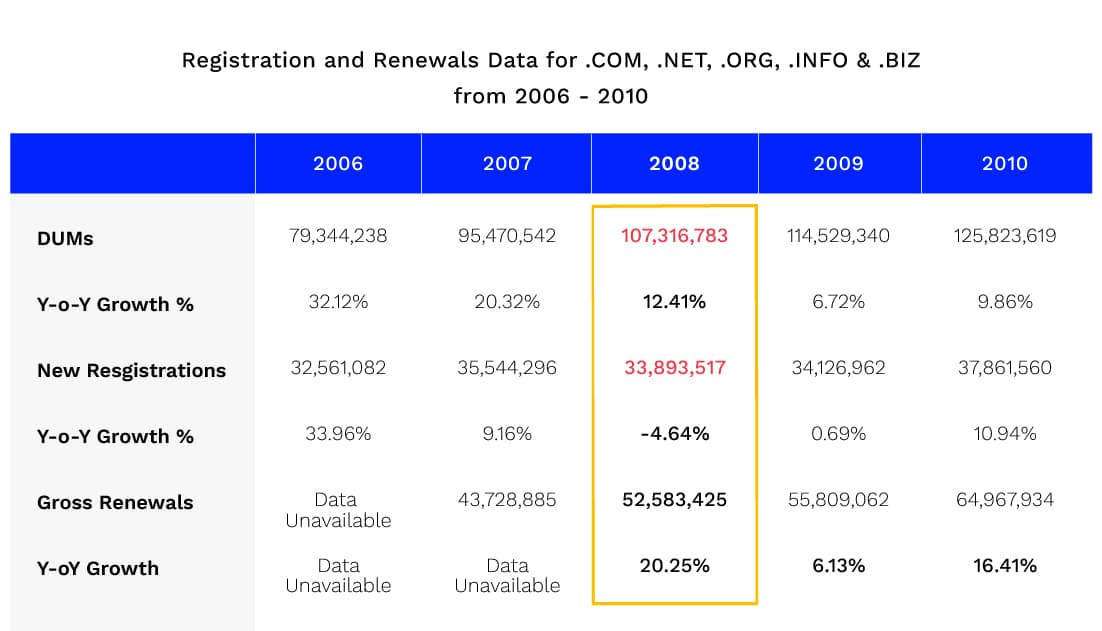
As detectable in the table above, from 2004 up to 2008, the DUMs were increasing by at least 20% YoY. However, in 2008, the YoY growth slowed down to 12%~, and further down to 6%~ YoY in 2009.
Assumptions and Data Details:
And as can be seen here as well, the first year renewals dipped to 45% in 2009, from a much higher average of ~58% in the previous years. This could be attributed to the overall market sentiment during that period, the quality of the names, and the general pressure on businesses.
Based on publicly available data, the domain industry, on the whole, has reported a surge in domain name registrations since February 2020. Legacy gTLDs’ new registrations have seen a 5%~ jump in March 2020 and 10%~ jump in April 2020 when compared to the average monthly registrations for 2019. (Refer to table below)

This is great news for our industry. In fact, we have seen a rise of 15-20% in registration volumes at Radix too. This is not limited to standard domain registrations; we saw a 22% increase in premium domain registrations as well and a 15% increase in premium domain revenue in March-May vs the previous 6 months.
While .online saw a 45% increase in premium registrations and a 38% increase in revenue, .store saw a 70% increase in premium registrations and a 93% increase in revenue. This is clearly an indication of the urgency across industries to go online with meaningful, brandable names.
It’s too early to celebrate, though. While we expect these registrations to be backed by meaningful usage, we have to take into consideration that this surge could be a result of knee-jerk, reactive reasons. So, obviously, we ought to be cautious when predicting the renewal rates for the next year.
We cannot ignore the fact that times are vastly different now when compared to 2008. The society is more dependent on the Internet today than ever before. And if that wasn’t enough, the pandemic has further accelerated the transition from offline to online for businesses across the board.

This is a unique situation for our industry. As more and more businesses, institutions, and even next-door services are going online and speedily evolving their technology usage, our industry stands to play a crucial role in this mix.
So, our guess is as good as yours when it comes to expecting the future. At Radix, we live and breathe data! And yet, at an interesting juncture like this, there isn’t any data that we can rely on 100%. For what it’s worth, we have looked at the past. As for the future, it seems to be hanging on that big “however” we spoke of above.
24World Media does not take any responsibility of the information you see on this page. The content this page contains is from independent third-party content provider. If you have any concerns regarding the content, please free to write us here: contact@24worldmedia.com